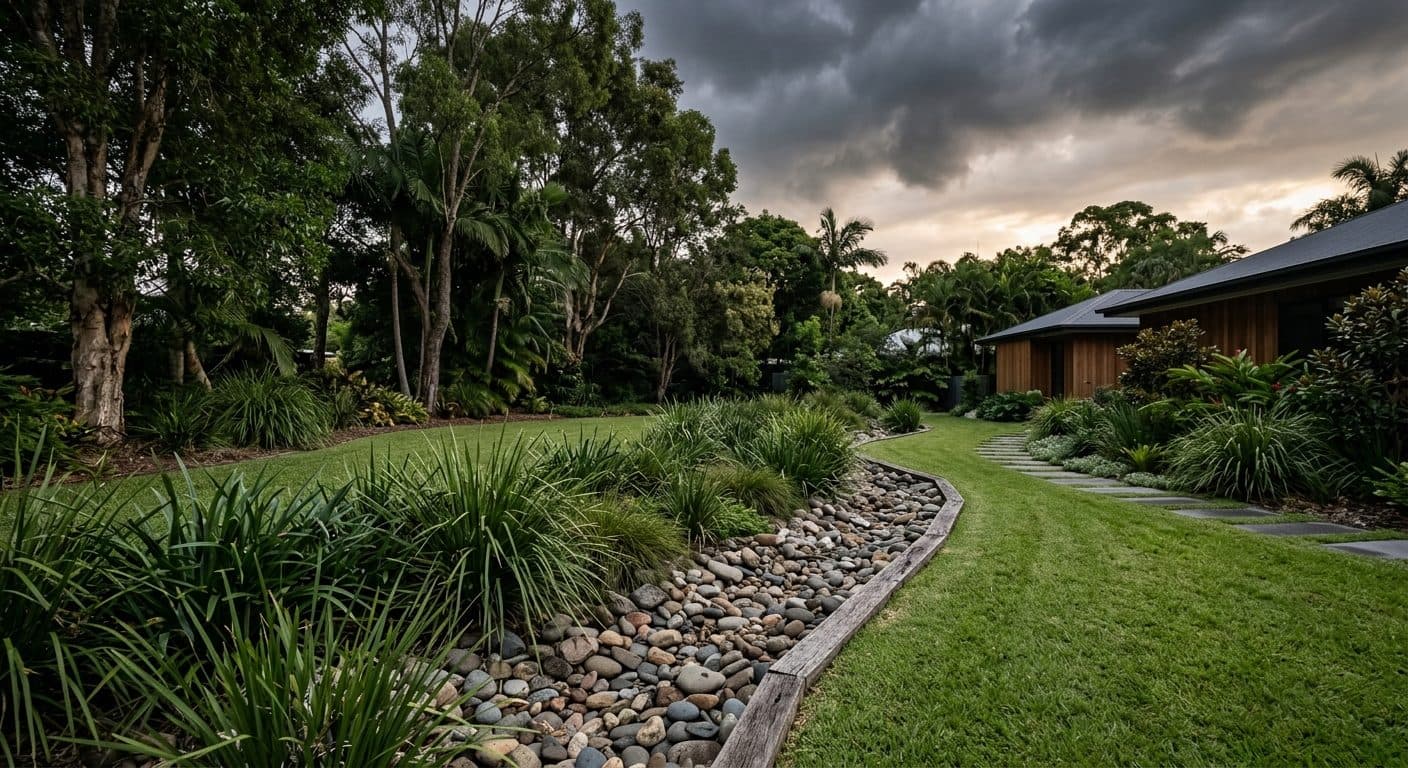
A Brisbane storm doesn't ask permission. Here's how I design gardens for the wet season, so the water runs where you chose rather than where gravity improvises.

By Shannon Trevisiol, Landscape Designer, Brisbane · 4 min read
- Storm-proofing is a design job done at the start, not a clean-up job done after: decide where the water goes before gravity decides for you.
- On Brisbane's reactive clay, rain gardens and swales that slow and soak water beat piping everything straight to the street.
- Every square metre of sealed paving sheds water somewhere, so balance hard surfaces with permeable ones.
- Most storm tree failures are avoidable: wind-firm species, correct staking, and planting for year ten rather than year one.
A Brisbane storm doesn't ask permission. One February afternoon the sky turns a strange green, and twenty minutes later you're watching a brown sheet of water run across the lawn, over the patio and straight at the back door. The gardens that come through the wet season well aren't the lucky ones. They were designed for the water long before the water arrived.
Storm-proofing a garden is a design decision, not an emergency, and most of the work is invisible once the plants grow in. It comes down to three things: deciding where the water goes before it decides for itself, choosing surfaces and plants that cope with both the downpour and the dry weeks either side, and putting trees in the ground that will still be standing when the wind drops. Here's how I think about each one.
Decide where the water goes before it does
The single most important move is giving stormwater a planned path off your block, so it runs where you chose rather than where it improvises. On a flat site that means getting the falls right, a gentle, deliberate slope that carries water away from the house and towards a legal discharge point. On a steep site it means reading the whole catchment, because water arriving from the neighbour uphill is your problem the moment it crosses the boundary. This is the heart of good sloping block design, and it's the part people most often get wrong when they landscape by eye.
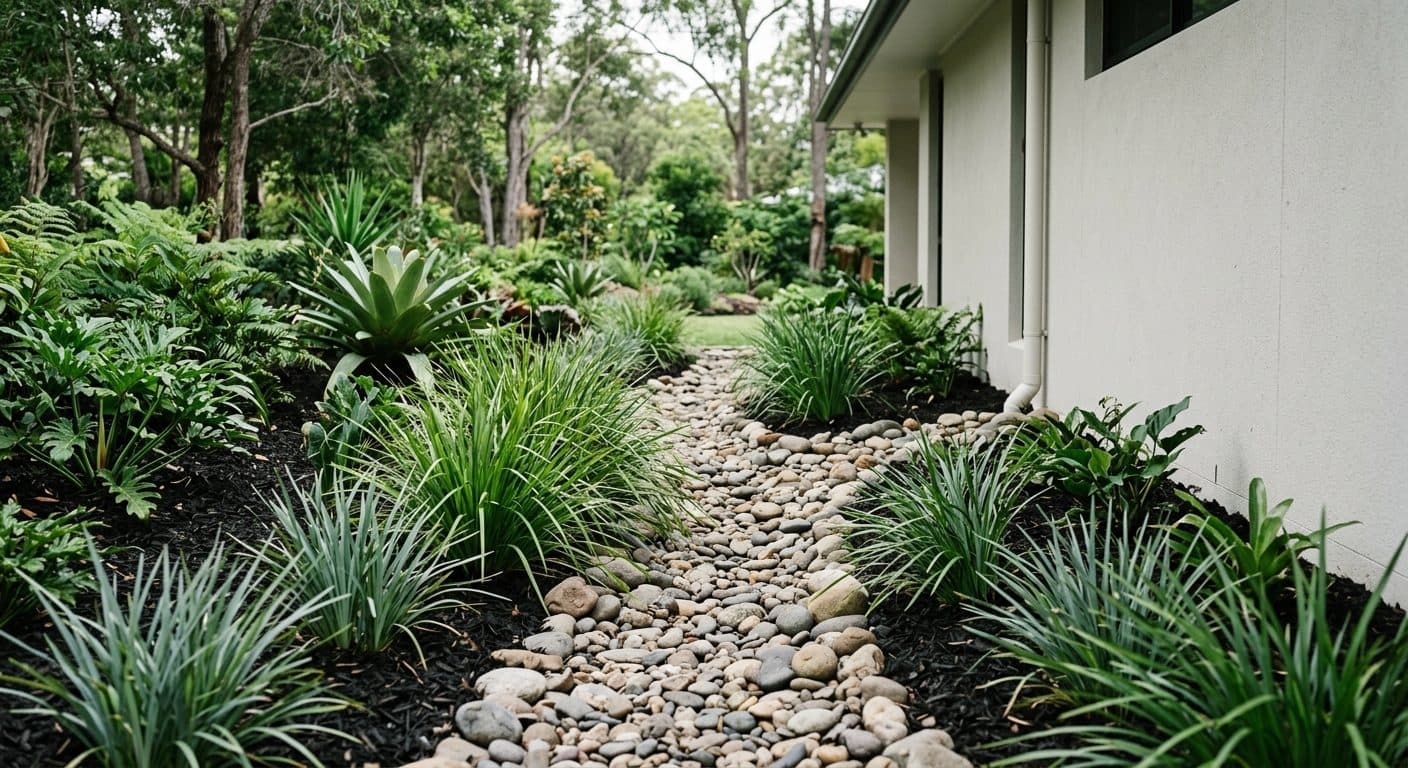
The mistake I see most is beds and paving built up hard against the house with nowhere for the water to go but back towards the slab. Once you've mapped where the water wants to travel, you can design an overland flow path into the garden itself, a shallow planted channel or a run of river stone that looks like a design feature and quietly does the work of a drain.
Rain gardens and swales, not just pipes
Slowing water down and letting it soak in is usually better than rushing it away. A rain garden is a planted depression that catches roof or surface runoff, holds it briefly, and lets it filter into the ground, and a swale does the same job along a contour. Both take pressure off the stormwater system in a heavy downpour and put that water to use rather than sending it straight to the kerb.
The honest caveat for Brisbane is the ground itself. Much of the city sits on reactive clay that swells when wet and drains slowly, so a rain garden here has to be built for it, with the right soil profile, a generous gravel base and an overflow for when the rain outlasts the soil's patience. If you're on heavy ground, my guide to plants for clay soil covers the species that actually cope with wet feet followed by a dry winter.
Permeable versus sealed surfaces
Every square metre of sealed paving sheds its rain somewhere else, so the more of your block you seal, the harder the rest has to work. Balancing hard surfaces with permeable ones (open-jointed pavers, gravel, decomposed granite, or a permeable paving system) lets a good share of the rain soak in where it lands instead of sheeting across the garden. It's a design decision with trade-offs around cost, maintenance and how a surface handles the summer heat, and the right mix is different for a compact courtyard than for a big entertaining terrace.

Wind-firm trees, and what actually fails
Most storm tree failures are avoidable, and they cluster around a few causes: shallow-rooted or brittle species, young trees staked badly or staked forever, and root systems that never got the room to anchor properly. Choosing wind-firm trees suited to your soil and aspect, planting them where they can develop a proper root plate, and staking them low and loosely so the trunk can flex and strengthen (then removing the stakes once they've established) is most of the battle. The other half is planting for year ten rather than year one, giving a tree the space it will actually need so it isn't fighting the house, the fence and the pipes for room.
One practical note before you reach for the chainsaw or plant something large near a boundary: significant vegetation work and some structures can trigger council rules, so it's worth checking the current council approval requirements rather than assuming. I design the planting and the drainage together, because a storm finds every shortcut in both.
If your garden turns into a river every February, that's a design problem with a design solution. Our Design Discovery Consultation is the place to start, and we'll look at where your water actually goes before we talk about a single plant.
Ready to start designing?
We're currently taking on new landscape design clients across Brisbane. Reach out for a personalised quote, whether you're a homeowner or a design professional.
Book a Free Discovery Call