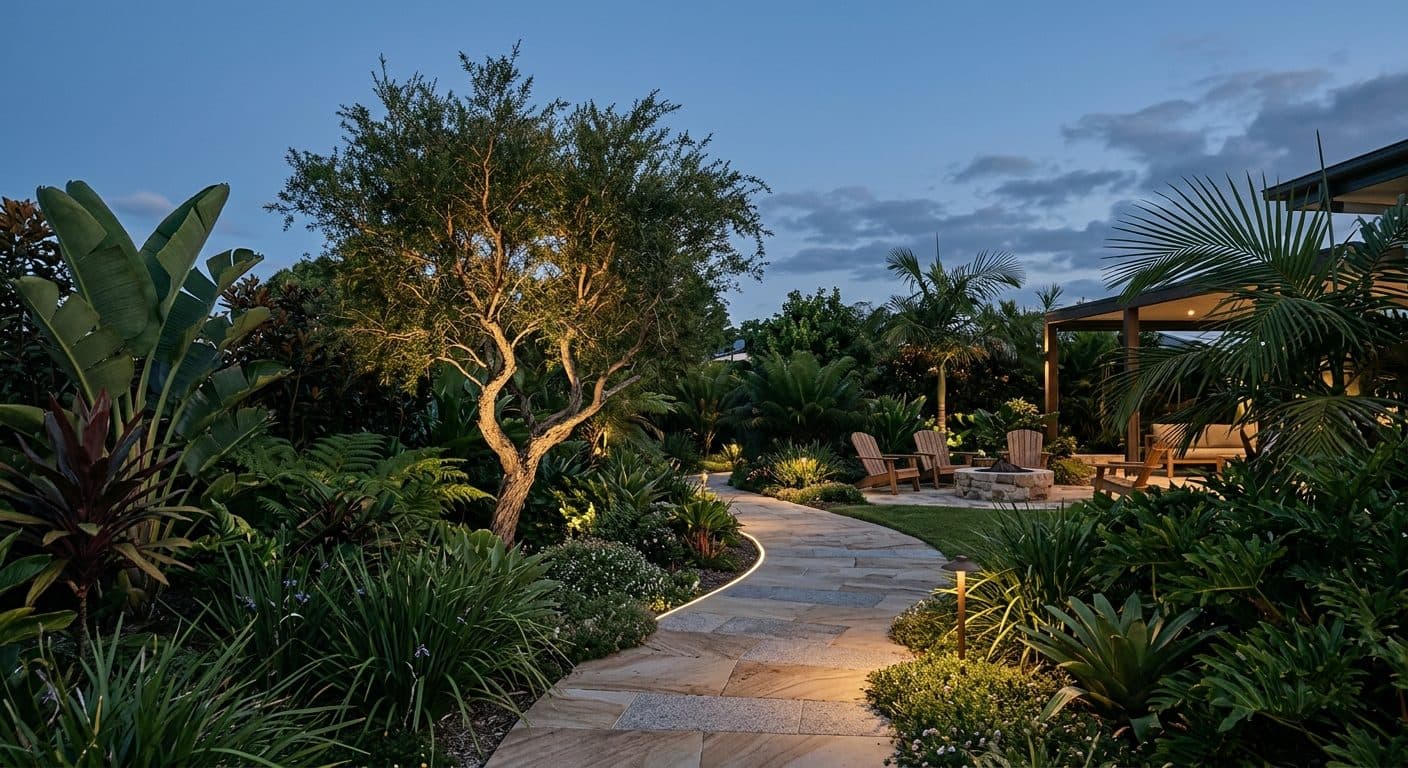
Good garden lighting is what lets you use the space after dark, and it's design, not decoration. Here's how I layer light in a Brisbane garden, and why warm and restrained beats bright and blue.

By Shannon Trevisiol, Landscape Designer, Brisbane · 5 min read
- Lighting is what extends outdoor living into the evening, so it's a design layer to plan, not a set of fittings to bolt on at the end.
- Layer the light: path lighting for safety, uplighting for drama, and a soft wash for atmosphere, rather than one harsh floodlight over everything.
- Go warm. A warm colour temperature flatters subtropical foliage and feels inviting, where cool blue-white light makes a garden look like a car park.
- Less is more: light a few things well, avoid glare and spill into the neighbours, and leave some darkness for the effect to read against.
- Building in stages? Lay empty conduit to every future lighting zone while the ground is open, so an electrician can pull cables through later without ripping up paving, edging or turf.
A garden you designed for the outdoors deserves to be usable after the sun goes down, and in Brisbane, where the best of the evening often comes after a hot day, that means lighting. But garden lighting is one of the most misunderstood parts of a landscape. Most gardens get one of two treatments: nothing at all, so the space simply disappears at dusk, or a single harsh floodlight that turns the whole yard into a service station forecourt. Neither is design. Good lighting is a layer you plan, as deliberately as the planting or the paving, and when it's done well it makes a garden more beautiful at night than it is by day.
The principles aren't complicated, they're just usually skipped. Light with intent, keep it warm, and leave some darkness for the light to work against. Here's how I approach it.
Layer the light by the job it's doing
The core idea is layering: different lights doing different jobs, rather than one fitting trying to do everything. Path and step lighting is the safety layer, low and shielded so it shows you the ground without dazzling you. Uplighting is the drama layer, a light at the base of a tree or a feature wall throwing the form and texture up into the dark, which is where a garden gets its night-time theatre. And a soft general wash is the atmosphere layer, gentle pools of light over the seating and gathering spots that make a space feel warm and lived-in. Get those three working together and the garden gains a whole second life after dark, which is really the point of any outdoor entertaining space, that it keeps working once the sun's gone.
Go warm, and flatter the foliage
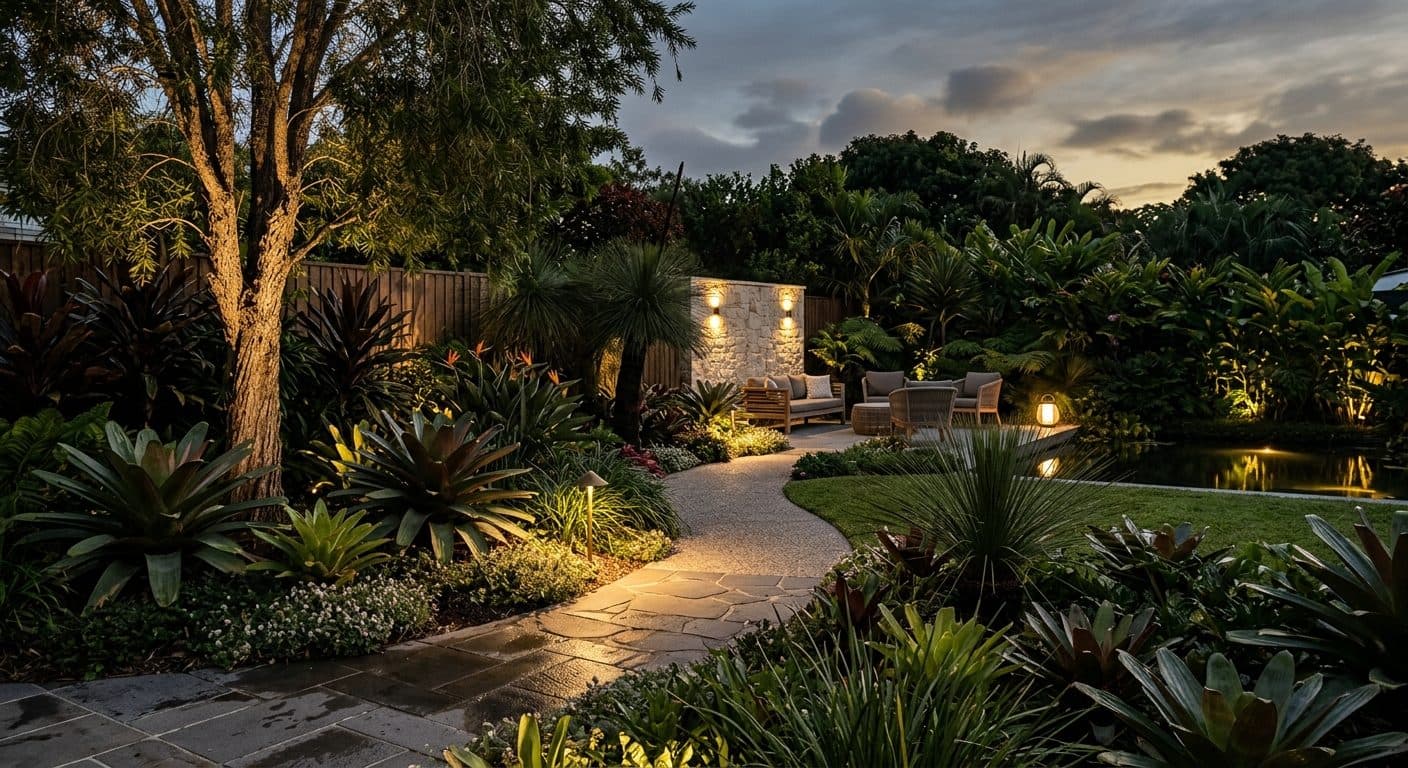
Colour temperature is the decision that separates a garden that glows from one that looks clinical, so go warm. A warm white light brings out the greens of subtropical foliage and makes a space feel inviting and relaxed, where a cool, blue-white light drains the colour out of planting and gives the whole garden the charm of a loading dock. I stick to warm tones throughout and keep them consistent, because a mix of warm and cool fittings reads as an accident. This is the same instinct that runs through good modern garden design, where restraint and consistency are what make a space feel resolved rather than busy.
Restraint: light a few things well
The most common mistake in garden lighting is too much of it, so light selectively. A garden where everything is lit has nowhere for the eye to rest and none of the depth that makes a night garden lovely, whereas lighting a handful of the best things, a sculptural tree, a textured wall, the path you need to see, and letting the rest fall into shadow, gives you contrast, mystery and a sense of depth. I also watch glare and spill hard: a fitting you can see the bulb of is a fitting doing its job badly, and light thrown over the fence into a neighbour's bedroom is a fast way to sour a good relationship, so I aim and shield everything to light the garden and not the people in it. The same warm, restrained lighting is what makes a fire pit or outdoor room feel finished, and what lets people move safely once the fire burns low.
The practical side: low voltage, and a licensed sparky
On the technical side, most garden lighting today is efficient low-voltage LED, which is safer to run through a garden, gentler on the power bill and flexible enough to adjust as the planting grows in, and I design the layout, the zones and the switching as part of the plan so it's considered rather than improvised. Where the system connects to mains power, though, that work is for a licensed electrician, not a weekend job, so I design the intent and the positions and leave the wiring and connection to the qualified trade, which is both the safe way and the compliant one. It's worth budgeting the electrician into the project from the start rather than treating it as an afterthought.
Rough in the conduit while the ground is open
If you're building the garden in stages, lay the empty conduit to every zone you might one day light while the ground is still open, even if the lighting itself is years away. Running a length of conduit under a path, through a garden bed or across the lawn during construction costs very little, but going back for it later means cutting into finished hardstand, lifting garden edging and digging up established turf to do a job a bit of foresight would have avoided. Then, when the budget comes around, a licensed electrician can simply pull their cables through the conduit you left waiting, and the lighting goes in without tearing the garden apart. It's the same stage-by-stage thinking behind phasing a garden renovation: do the disruptive, buried work once.
If your garden goes dark and unused the moment the sun drops, lighting is one of the highest-impact things you can add. Our Design Discovery Consultation is where we start, walking the garden and working out what's worth lighting and how.
Ready to start designing?
We're currently taking on new landscape design clients across Brisbane. Reach out for a personalised quote, whether you're a homeowner or a design professional.
Book a Free Discovery Call